
Fields Inside Coahoma County Property Tax Records
Assessment and collection sit in two different offices. The Coahoma County Tax Assessor sets each parcel's appraisal and classification. The Tax Collector then issues the bill and takes payment. A parcel number and tax year should line up on both sides. Compare figures only after they match. Matching the tax roll entry to the tax bill is the quickest way to spot an error.
| Record field | What it answers | County source |
|---|---|---|
| Appraised or true value | The assessor's estimate before the class ratio is applied | Assessor roll and comparison report |
| Assessed value | The portion to which millage is applied | Assessor record |
| Land Owner Name | The name printed on the dated appraisal report | 2026 and 2025 comparison report |
| Exemption | Whether homestead or another approved reduction affects tax | Assessor and homestead file |
| Bill and payment status | Tax due, installments, payment, or delinquency for a stated year | Tax Collector portal or counter |
An appraised value is not a sale price. A GIS total is not the amount due. The bill grows out of assessed value. Exemptions and the millage set for that tax year finish the math. For help reading the numbers themselves, the Coahoma County property value guide breaks them down.
The county lists its assessment duties and report links on the official source page.
Open the Coahoma County Tax Assessor and Tax Collector page. It has the joint office detail below.
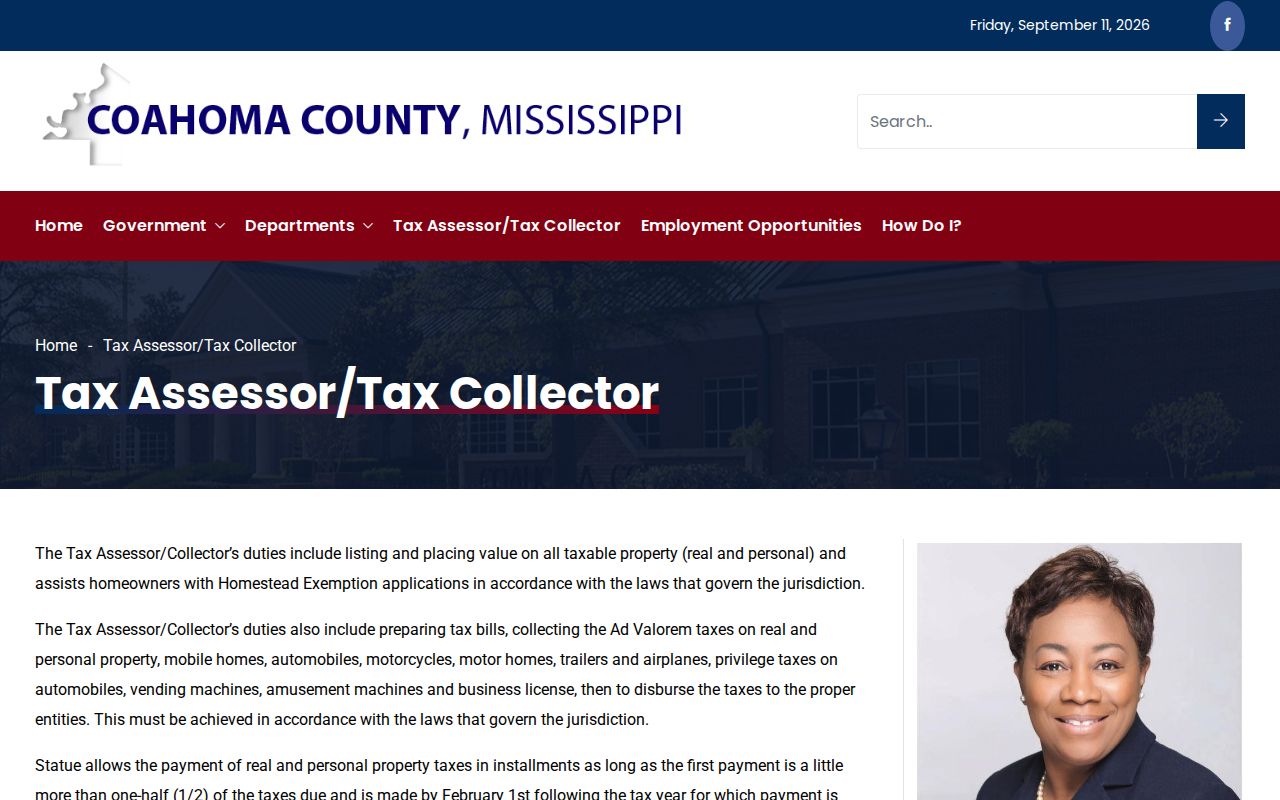
That page shows the combined office behind appraisal reports, homestead filing, collection, and tax-sale questions.
The Coahoma County 2026 and 2025 Appraisal Comparison
Coahoma County publishes a static real-property comparison report dated July 16, 2026. Each row lists Beat, Parcel ID, and Land Owner Name. It also shows the 2026 Appraised Value, the 2025 Appraised Value, and a signed Difference. That format works well for spotting a value change or copying an exact parcel key.
The report shows no deed. It lists no sale price, no tax due, and no reason for a change. Owner of record names run in uppercase. They may take LLC, estate, trust, ET AL, or ET UX forms. Keep that exact wording. Use the full Parcel ID, spaces, leading zeros, and letter segments included, when you move to the payment lookup.
Note: A comparison row is an audit clue. It is not a bill or proof of a completed transfer.
How Coahoma County Property Tax Moves From True Value to Tax
Mississippi runs an ad valorem system. True Value times the Assessment Ratio yields Assessed Value. Assessed Value times Millage yields the tax. An exemption and the rates of the taxing authorities that apply can then adjust the final bill.
- True or appraised value
- The assessor's estimate of full value for tax administration.
- Assessment ratio
- The percentage fixed by Mississippi property class.
- Assessed value
- The result after the class ratio is applied to true value.
- Millage
- The levy applied to assessed value by the relevant taxing authorities.
- Tax lien
- The public claim that can arise from unpaid property tax, requiring a status check with the Collector and land records.
Class I covers single-family, owner-occupied residential real property, assessed at 10 percent of true value. Class II covers other real property at 15 percent. Classification shifts the assessed base, so two Coahoma County parcels with the same true value can carry different assessed figures.
Find a Coahoma County Property Tax Bill Step by Step
Begin at the county Pay Online page. It routes you to View/Print Taxes, Real and Personal Tax, Business Search, and Mobile Homes. The linked Coahoma real-property system is a JavaScript application, so keep the county page and the counter as fallbacks if it fails to load.
- Identify the exact parcel in the assessor comparison report or county GIS and copy the full parcel number.
- Open the Coahoma County payment hub and choose the real-property or view-and-print tax route.
- Match the parcel, tax year, and owner label before treating any amount as the subject property's bill.
- Check the Assessor record separately for classification and exemption information.
- For missing years, payment history, or delinquency detail, contact the Tax Collector at 662-624-3020 or visit the county office.
The payment system publishes no clear statement of back-year coverage. Card fees, receipt fields, and every supported search mode also go unstated. Trust what the screen shows over assumption. An address search, a zero balance, or the first result page may each be incomplete.
The county's tax-payment hub lays out the separate view, print, real-property, personal-property, business, and mobile-home routes. Each route covers one records task. Pick the one that matches your tax bill.
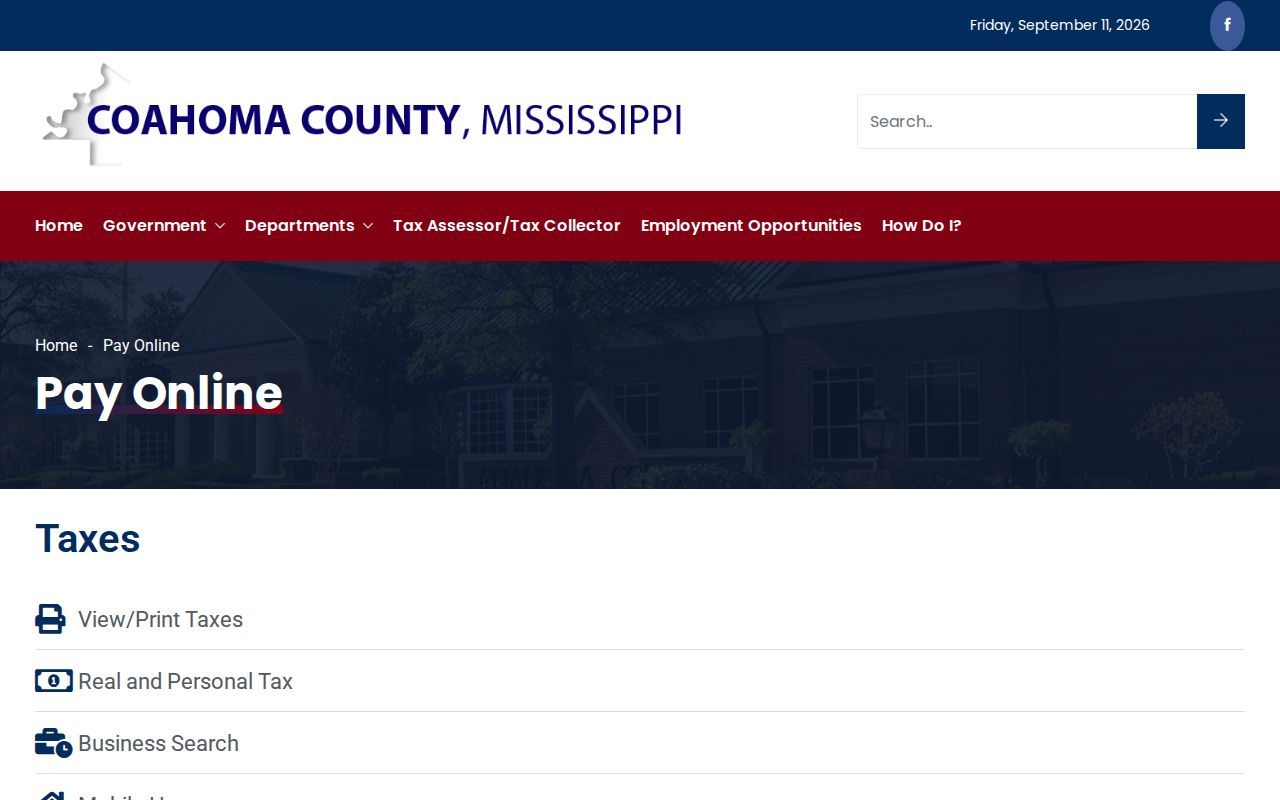
The hub lists the route choices only. It cannot establish a parcel's balance or payment status without a matching result.
Coahoma County Homestead Filings and Change Events
Homestead filings go through the Tax Assessor, not the payment portal. Coahoma County lists the conditions plainly. An applicant must own the home, occupy it as a primary residence, hold a Mississippi vehicle tag, meet state income-tax duties, and claim only one residence statewide. The first filing happens in person.
Applications are due by April 1. After that, renewal is automatic unless a listed change occurs. A new filing is required after marriage, divorce, separation, or the death of a spouse or joint owner; after any change in ownership, use, or occupancy; after a new property or legal description; or at the first claim based on age 65 or 100 percent disability.
File the right record. A tax payment does not create or renew homestead status. Confirm a new or changed claim with the Coahoma County Tax Assessor before April 1.
When Coahoma County Property Tax Is Paid in Installments
Coahoma County allows real and personal property taxes to be paid in installments. The first payment, slightly more than half the bill, must arrive by February 1 after the tax year. The second and third installments accrue 1 percent monthly interest on the unpaid balance.
Treat those rules as a schedule guide. Read the actual bill for the parcel and year in question. A portal balance can shift after a payment posts. A correction can land. A delinquent amount can move into a different process. Whenever payment status matters, save a dated receipt or a printed detail screen from the tax records.
Coahoma County Delinquency, Sale, and Forfeiture Records
A late tax bill is one thing. A completed tax sale is another. The Tax Collector handles bills and delinquency questions. The Chancery Clerk keeps the land and tax-sale records. Ask which record shows advertisement, sale, forfeiture, and redemption.
The Mississippi Secretary of State offers a tax-forfeited land search. Fields include county, address, subdivision, parcel number, PPIN, assessed owner, and legal description. The search also covers section, township, and range. Results appear ten at a time with property details. Remember it is a tax-forfeited-land tool. It is not proof that every current Coahoma County delinquency appears there.
Note: Label auction, forfeiture, or redemption only when the parcel-specific record shows that status. Match it to the date on that record.
Challenge a Coahoma County Property Tax Assessment
The Coahoma County Board of Supervisors reviews the tax roll. It also hears objections from owners who dispute a valuation. Mississippi guidance sets the usual county objection point. It falls on the first Monday in August before the tax due date. The Chancery Clerk should confirm the local meeting. It can also confirm filing method and evidence requirements for the year at issue.
Bring the parcel number to the hearing. Bring the Assessor's values and class. Add the comparison-report row, photographs or condition facts, and any relevant sale or appraisal evidence. Keep true value, assessed value, and the bill amount separate. That separation lets the office identify which figure is disputed.
Confirm the local window. Contact the Coahoma County Chancery Clerk before the usual August review date; the state's separate 60-day Review Board rule concerns certain Department actions.
Offline Routes for Coahoma County Property Tax Records
Online access is only one route. The Tax Assessor and Tax Collector share county duties. They can be reached at 662-624-3020, with business hours of 8 a.m. to 5 p.m. The Chancery Clerk, at 115 First Street in Clarksdale, handles land records and tax-sale files. Call ahead when a prior-year roll entry or certification is what you need.
Written requests may go to the Coahoma County Public Records Officer. Forms, letters, faxes, and email all work. Name the exact parcel, tax year, and record type. That could be a roll entry, bill, receipt, delinquency record, homestead application, sale record, or redemption record. The Mississippi Public Records Act allows reasonable search, duplication, and production fees. The county posts no exact copy schedule, though.