
Read Coahoma County Deed Records by Instrument
Every transfer of land in Coahoma County leaves a paper trail. It sits in the Chancery Clerk's land records. Each deed names the parties. It also describes the property. The deed carries execution and recording details plus a book and page or instrument reference. Read the deed alongside its legal description and the related indexes. A grantee name by itself tells only part of the story.
| Deed Type | What It Does | Common Use |
|---|---|---|
| Warranty deed | Conveys the stated interest with title covenants | Ordinary sale transfer |
| Quitclaim deed | Conveys whatever interest the grantor has, if any | Family transfer or title cleanup |
| Special warranty deed | Uses covenants limited to the grantor's period | Some negotiated or institutional transfers |
| Trustee or executor deed | Transfers through a fiduciary authority | Trust, estate, or authorized sale |
| Tax deed | Documents a transfer arising from tax proceedings | Tax-sale research |
Not every recorded document transfers land. A deed of trust or a mortgage secures a debt instead. The same is true of lis pendens, construction liens, and federal tax liens. They color the record trail. None of them ever acts as a conveyance of title.
The Chancery Clerk Keeps Coahoma Land Records
The Coahoma County Chancery Clerk serves as both recorder and clerk of the Chancery Court. The office sits at 115 First Street, Clarksdale, MS 38614. Call 662-624-3000, fax 662-624-3040, or write to P.O. Box 98, Clarksdale, MS 38614. Sherita Wilson is the clerk. Deeds, deeds of trust, mortgages, lis pendens, construction liens, powers of attorney, federal tax liens, and DD-214s all pass through this one office. It also handles Chancery matters such as estates and land disputes. The office collects prior-year taxes as well. The duties overlap. So say up front whether you want a recorded instrument, a court file, or help with taxes. View the county's Chancery Clerk record categories to see the full set before you call.
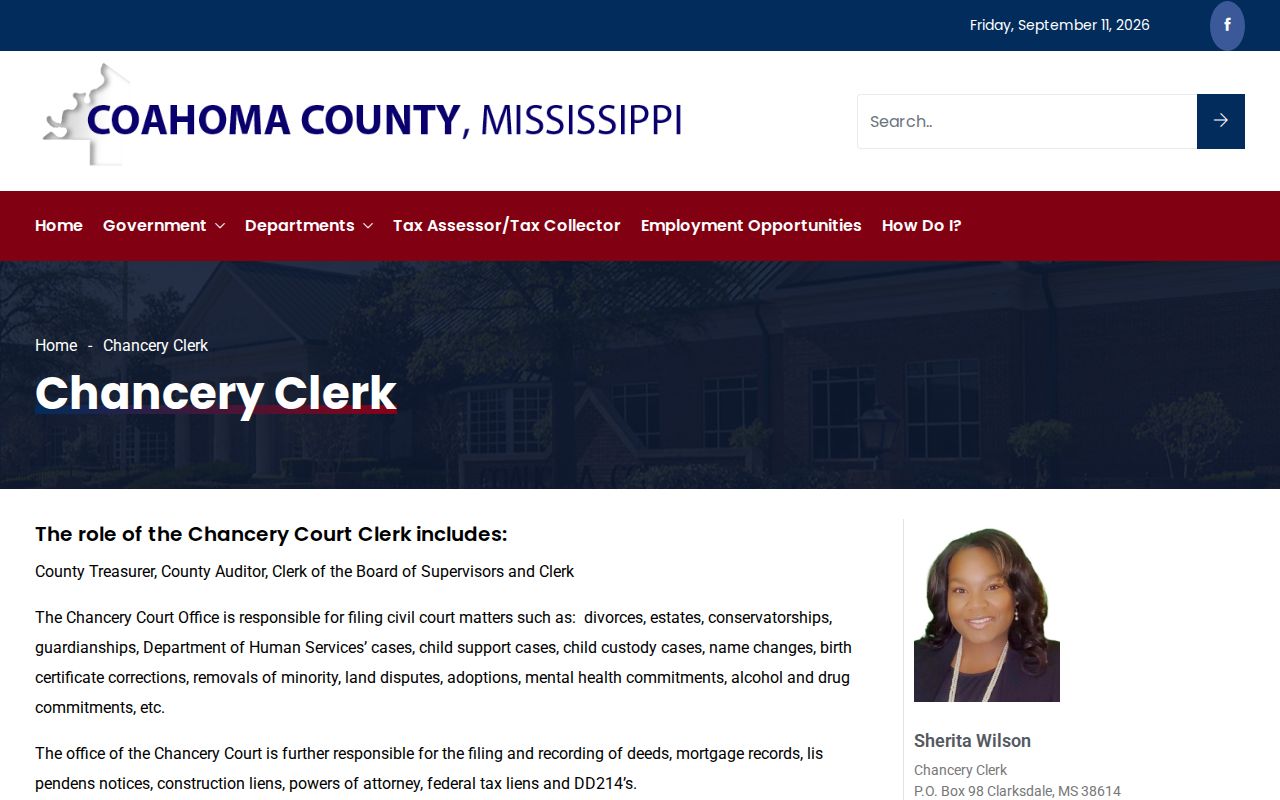
Deeds live in the same record system as mortgages, liens, and lis pendens. That shared filing is exactly why instrument-type notes matter.
Indexes Available for a Coahoma Deed Search
| Index or book | Use in deed research | Important distinction |
|---|---|---|
| General Index - Deeds | Find transfers by grantor or grantee | Index entry points to the instrument |
| General Index - Deeds of Trust | Find recorded security instruments | Not the ownership-deed index |
| Substitutions | Track changes tied to trust instruments | Read with the referenced deed of trust |
| Sectional Index | Approach rural land by land-grid location | Useful when an address is absent |
| Map/Plat Book | Connect lots, blocks, streets, and subdivisions | A plat is not a survey of current occupation |
| Lis pendens / lien indexes | Locate claims or pending property litigation | Does not itself resolve the claim |
The Land Title Association directory points to other research paths. These include federal civil judgments, the Chancery Index and Docket, and Board of Supervisors Minutes. Ask the clerk which index fits your event, rather than paging through books hunting for a conveyance that was never there.
Walk Coahoma's Grantor-Grantee Chain
The grantor-grantee method builds a chain one transfer at a time. Start from a deed known to describe the subject parcel. Then test each earlier party against that same legal description in the Coahoma County records, since a shared name alone never proves the same land changed hands.
- Use the GIS DEEDREF, legal description, or known current deed to find the acquisition instrument.
- Record the grantee, grantor, deed type, date, book/page or instrument number, and description.
- Search the grantor as a grantee in an earlier period to locate that party's acquisition.
- Repeat while comparing acreage, subdivision, lot and block, or section-township-range calls.
- Move to courthouse books, microfilm, or archives when the available digital trail ends.
- Grantor
- The party conveying the stated interest.
- Grantee
- The party receiving the stated interest.
- Chain of title
- The ordered series of instruments connecting successive interests in land.
- Book/page or instrument number
- The retrieval reference assigned to the recorded document.
Not every transfer fits a simple sale-to-sale pattern. A quitclaim, executor's deed, court decree, estate proceeding, or tax event can break the sequence. Follow the authority and references recited in each instrument instead of forcing the Coahoma deed chain into one shape.
No Published Online Cutoff for Coahoma Deeds
Coahoma County publishes no public deed-index URL. There is no digital-image starting year and no online coverage statement for its deed records. Access therefore runs through the Chancery Clerk. The counter, telephone, fax, and mail channels all work. Ask which years can be searched electronically. Also ask whether deed images are viewable before planning remote-only work.
The missing cutoff does not mean older deeds were lost. It means coverage must be verified. Bring party names, approximate years, deed or plat references, and legal-description clues to the clerk. For a long chain, one question matters. Ask whether the General Index - Deeds or the Sectional Index is the right entry point for your Coahoma County property search.
Coverage limit. Coahoma County has not published an official online deed cutoff in the inspected sources. Confirm the live index range with the Chancery Clerk and use deed books or archives beyond it.
An 1848 Coahoma Deed Shows the Archive Route
The Mississippi Department of Archives and History's Series 2050 holds an 1848 Webster-to-Wilkerson land record. The archive also holds nineteenth-century Coahoma original land, tax, court, and municipal records. Digitized assessment series cover the land years 1844, 1845, 1850, 1870, 1876, and 1883.
That trail gives researchers a real pre-digital route into Coahoma County property records. Search by parties and year first. Capture the series and item citation. Then connect the legal description forward through later deeds, assessment books, plats, or court orders. One surviving early record, though, is not continuous coverage.
Coahoma County was created in 1836. That year sets the jurisdictional frame. Each deed book and archive series still carries its own dates and gaps. Note the repository, series, box or reel, page or frame, and whether the item is an index, deed, assessment, or case record whenever you pull a parcel number or deed citation.
Two County Seats Can Appear in Older References
Coahoma County's record geography shifted over time. Clarksdale and Friars Point shared two judicial seats after the 1892 compromise. Clarksdale became the sole county seat in 1930. That means an older court or land reference may name Friars Point. A current request still goes through the Clarksdale courthouse. The historic label does not mean a parcel moved. An old court district also rarely matches a modern municipal boundary. Treat the old place name as one more search clue. Then compare parties, the land description, book and page, section-township-range, and any later parcel references before drawing conclusions about ownership.
Handle the city's documented 1889 fire and the region's floods with the same care. No official county history identifies a destroyed deed volume. Rather than assuming a title gap, ask the clerk. You can also ask the state archive whether a particular record series was affected.
Liens and Deeds of Trust Share the Recorder's Shelves
Deed records in Coahoma County hold more than conveyances. The clerk also records deeds of trust, substitutions, construction liens, federal tax liens, lis pendens, and federal civil judgments. A single property can carry a long paper trail. One deed of trust sequence may include the original security instrument, a substitution, a release or satisfaction, foreclosure records, and a later deed.
Search the exact party names plus the property description for the ownership period. A lis pendens flags pending litigation. It is not a final ruling. Likewise, recording a lien proves only that the document entered the public record, not that the claimed amount is still owed. Pull the instrument itself, along with any release, satisfaction, cancellation, or court disposition.
Note: Keep a separate timeline for ownership transfers and encumbrances so their dates and legal effects are not blended.
Probate and Chancery Cases Can Bridge a Deed Gap
The Chancery Clerk holds more than deeds. Estates, land disputes, partition matters, and quiet-title proceedings all sit in the same office. When no ordinary deed explains why a later owner of record appears, look further. Probate authority, a court decree, or another Chancery event tied to the property and its parties may hold the answer. A decree can transfer real estate. It works just as effectively as a deed recorded at the counter.
Coahoma County Chancery Court joined Mississippi Electronic Courts on October 24, 2016. Public PAMEC access requires registration. Pages cost $0.20, and a no-match search still carries a one-page charge. That 2016 date is a case-system milestone, not the start of county deeds. Earlier or non-electronic cases may still need help from the clerk.
Request a Coahoma County Deed Copy
A complete request helps the Chancery Clerk find the deed fast. Give the grantor and grantee, an approximate recording date, the deed type, a legal-description clue, and any book/page, instrument, parcel, DEEDREF, or PLATREF number you have. Requests can be made in person at 115 First Street, by phone at 662-624-3000, by fax at 662-624-3040, or by mail to P.O. Box 98, Clarksdale, MS 38614.
The office publishes no current deed-copy or certification fee. Ask about the amount, payment methods, processing time, and whether an image can be sent remotely. Also say whether you need a plain informational copy or a certified copy.
Recorded, not guaranteed. Coahoma County deed records show instruments accepted for recording. Recording does not create a title opinion, settle a boundary, or reveal every unrecorded interest; professional title and survey work may still be necessary.